Choosing a 16-channel mixer for music audio production often comes down to how you want to connect your gear and how much technical detail you want in the spec sheet. Both of these mixers sit at the same $120.85 price point, but they emphasize different strengths: one makes Bluetooth and USB input the headline feature, while the other leans into professional-style console specifications.
Quick verdict
If you want to wirelessly stream audio from a phone or tablet and connect a USB device without hunting for adapters, the 16 Channel Studio Audio Mixer Bluetooth USB Digital Sound Mixing Console Board is the straightforward pick. If you'd rather work with a console that spells out its performance numbers - like crosstalk, distortion, and noise figures - the 16 Channel Audio Mixer Professional Sound Board Mixer DJ Mixing Console System is the one that gives you that extra engineering confidence.
At a glance
| Feature | Studio Audio Mixer | Professional DJ Sound Board |
|---|---|---|
| Listed price | $120.85 | $120.85 |
| Channels | 16 | 16 |
| Frequency response | 20Hz-30kHz±0.5dB | 20Hz-30kHz±0.5dB |
| Headline extras | Bluetooth, USB | Crosstalk >85dB, THD <0.01% |
| Overall bar |
Where each mixer wins
The Studio Audio Mixer wins for portability of input sources. Its title calls out Bluetooth and USB, so you can bring in a phone, tablet, or laptop signal without relying on additional interfaces. The description also mentions high-precision audio resolution and accurate vocal adjustment, which makes sense for podcasting, home recording, or live streaming where voice clarity matters.
The Professional DJ Sound Board wins for spec transparency. It publishes crosstalk figures (greater than 85dB at 1kHz), total waveform distortion (less than 0.01%), and equivalent input noise (-122dBu). If you are the type of user who wants to verify a mixer's technical behavior before buying, this listing gives you more to hold onto.
Product notes
16 Channel Studio Audio Mixer Bluetooth USB Digital Sound Mixing Console Board
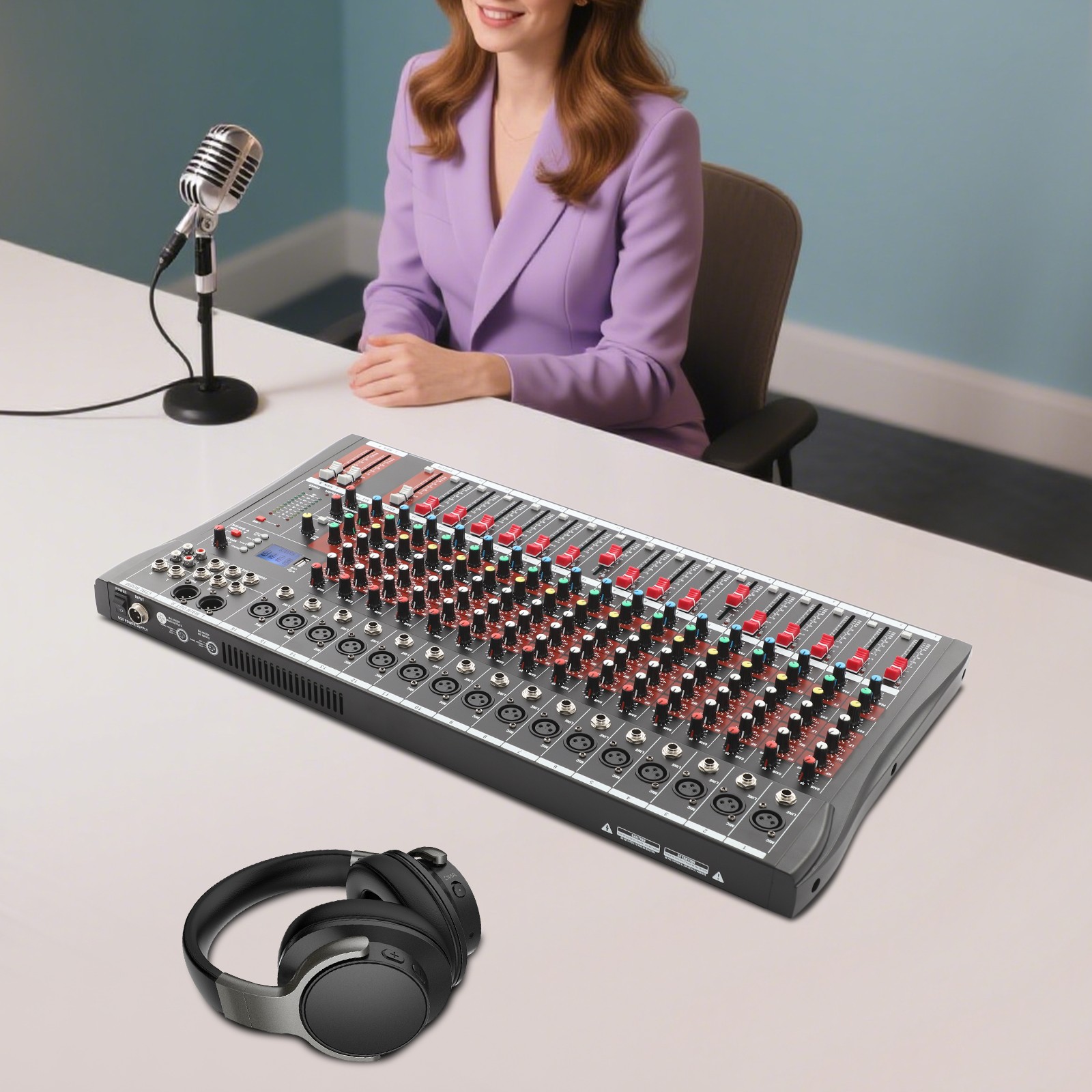
This mixer is your connection-friendly option. The Bluetooth and USB inputs are the obvious reason to choose it, letting you work with wireless devices and USB sources in the same session. The listing emphasizes simple operation and high compatibility, and it includes a 20Hz-30kHz±0.5dB frequency response. For a home studio or a content creator who juggles multiple devices, the convenience factor is strong. The limitation is that the listing does not detail crosstalk, distortion, or noise specs as clearly as the competing mixer, so if you need those hard numbers before committing, you'll find more of them on the other model.
16 Channel Audio Mixer Professional Sound Board Mixer DJ Mixing Console System
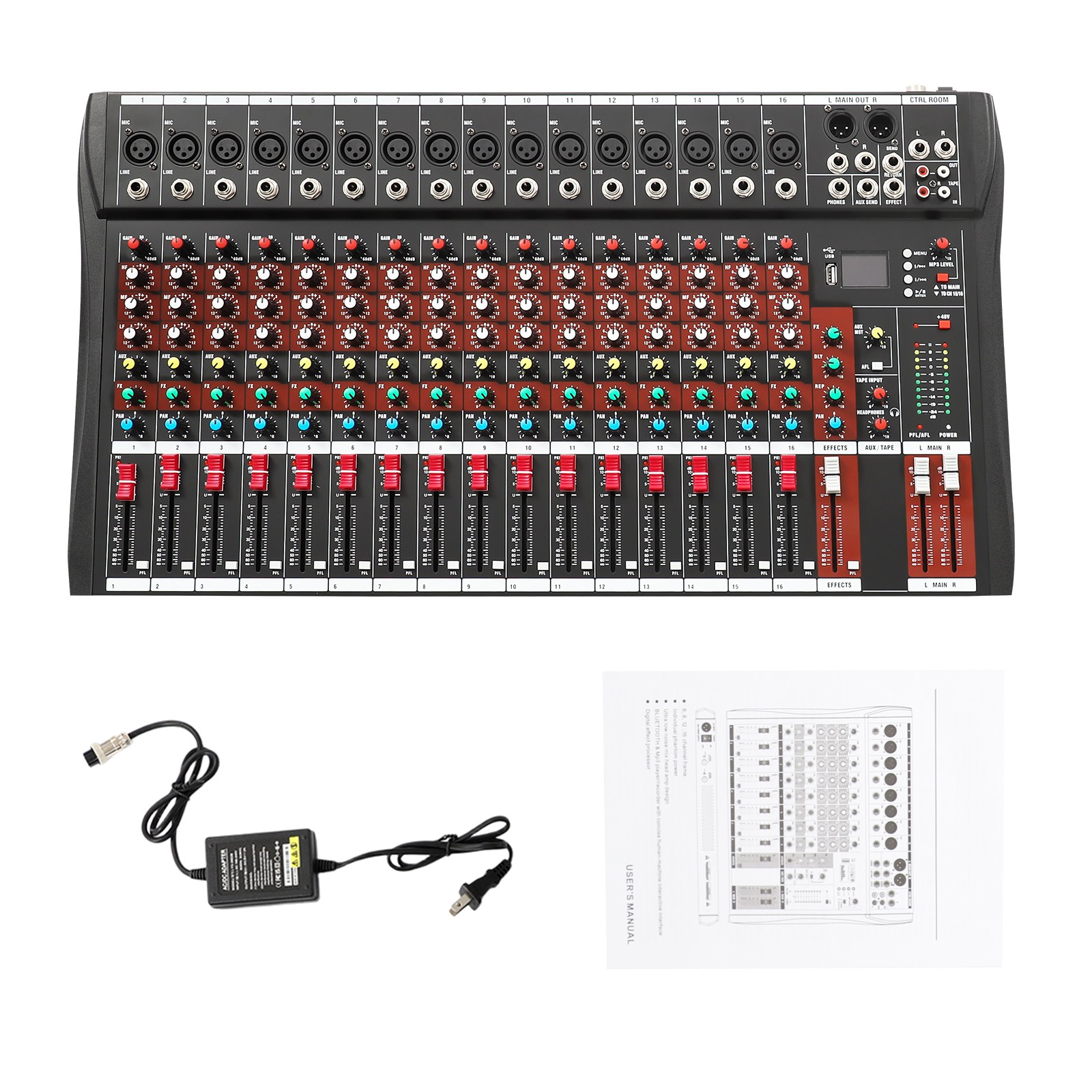
The professional sound board makes its case through published performance measurements. You get crosstalk greater than 85dB at 1kHz, total wave distortion below 0.01%, and a noise figure of -122dBu equivalent input noise. It also lists a 16-channel layout, 20Hz-30kHz frequency response, and a US standard adapter input. This is the mixer to pick when you want a traditional console feel and you appreciate seeing the engineering details in the listing. The trade-off is that Bluetooth and USB are not advertised here, so you'll need separate adapters or interfaces for wireless or direct digital device input.
Final choice by use case
Choose the Studio Audio Mixer if your day-to-day involves Bluetooth speakers, a USB microphone, or frequently connecting mobile devices. Its strength is input flexibility.
Choose the Professional DJ Sound Board if you're setting up a fixed rack or desk and you want the reassurance of specified crosstalk, distortion, and noise performance for DJ or live sound work. Both mixers sit at the same listed price, so the decision really comes down to whether you value wireless/USB convenience or professional spec depth.